 Log In






Clear, simple English is a powerful tool for any business.
Whether you’re firing off emails, writing contracts, or creating marketing copy, plain English helps people understand you first time around. No head-scratching required.
But too often, businesses hide behind complicated language that looks smart but says very little. (We see you, “leveraging synergies for scalable impact with strategic solutions.”)
That’s where plain English comes in.
This plain English guide is for anyone writing emails, website copy, reports, or internal docs – especially if your audience isn’t as familiar with your world as you are.
What is plain English?
Plain English is writing that says what it means, and means what it says. No fluff, no fuss.
It’s about choosing everyday words, keeping sentences short, and using active verbs that get straight to the point. The goal is to make your message easier to read and quicker to understand.
For business owners, this means better communication with customers, employees, and partners. It helps avoid confusion and mistakes.
Plain English doesn’t mean:
- Dumbing things down
- Skipping the important bits
- Making everything sound like a text from your mate
It's not about being less professional - just more understandable. And who doesn't want that?
When you use plain English, things run more smoothly. Customers know what you’re offering. Team members don’t need to translate a wall of corporate speak before they can act on it. And you stop spending hours rewording that one awkward sentence that doesn’t quite hit the mark.
It’s faster to write, it’s faster to read, and it helps you get your message across clearly – in all forms of communication.
Why plain English matters in the business world
Let’s face it: business communication is relentless. Between emails, Teams chats, reports, and the occasional “quick” meeting that somehow lasts an hour, we’re all juggling words non-stop.
According to Grammarly:
- Employees spend about half their week writing.
- 88% of their workweek involves communication
- Business leaders are using more communication channels than ever before.
So if your message isn’t clear the first time? That’s a problem.
Customers get frustrated, and employees need extra time to figure things out.
Using plain English in business has many benefits:
- Less confusion
- Fewer mistakes
- Quicker decisions
- Happier customers
- Clearer legal documents
- More inclusive communication
If you’re still clinging to phrases like “going forward” or “driving efficiencies,” take a breath and ask: “Would I say this to a friend?” If not, it might be time for a rewrite.
The problem with business jargon
So, what’s jargon meaning in this context? Simply put, it’s the insider language or terminology that makes sense to you but leaves others scratching their heads.
A little lingo might feel slick in a meeting, but to the outside world it often sounds like gibberish - or worse, like you're hiding something.
Some classics to (gently) retire:
- “Leverage” → “Use”
- “Touch base” → “Talk”
- “Circle back” → “Follow up”
- "Value proposition" → "Benefit"
- “Low-hanging fruit” → “Quick win”
Before using a word, ask yourself: "Would someone outside my industry understand this?"
If not, try using simpler words. If a term is necessary, explain it clearly.
Just because it sounds impressive doesn’t mean it communicates anything. Clarity > cleverness. Every time.
How to write in plain English
Here are eight tips your future self (and readers) will thank you for:
1. Swap fancy words for simple ones
It’s easy to think more complex language shows expertise. Although expert-level writing often uses specialised language, the wording in this kind of writing isn’t what communicates its authors’ expertise.
Simple doesn’t mean sloppy - it means smart.
That means waving goodbye to jargon, acronyms, and overly complex terms. When you do need them, include a short explanation.
- Before: “We deliver impactful, scalable solutions”
- After: “We help businesses grow.”
2. Trim the fat
Cut anything you wouldn’t say out loud. If it sounds like a corporate robot wrote it, it probably needs a trim.
Experts say that clear writing should have an average sentence length of 15 to 20 words.
This doesn’t mean making every sentence the same length. Be punchy. Vary your writing by mixing short sentences (like the last one) with longer ones (like this one).
Follow the basic principle of sticking to one main idea in a sentence, plus perhaps one other related point.
- Before: "In light of recent developments, we are currently in the process of implementing several key strategic initiatives aimed at enhancing operational efficiencies."
- After: "We’re making changes to improve how we work."
3. Use active voice
Passive voice often pops up when people want to dodge responsibility – especially when giving bad news or talking about processes.
Let’s look at an example:
“A decision has been made to terminate your contract.”
Ouch.
It’s lengthy, detached, and a little awkward. We’ve made a decision, so it’s only fair to own it. From the reader’s point of view, we could look a bit suspicious if not.
Here's the ‘active' version:
“We’ve decided to end your contract.”
(This could also be “I've decided to end your contract”, depending on the situation. The key point is that we say who's responsible.)
Active voice is more confident, more human, and more honest.
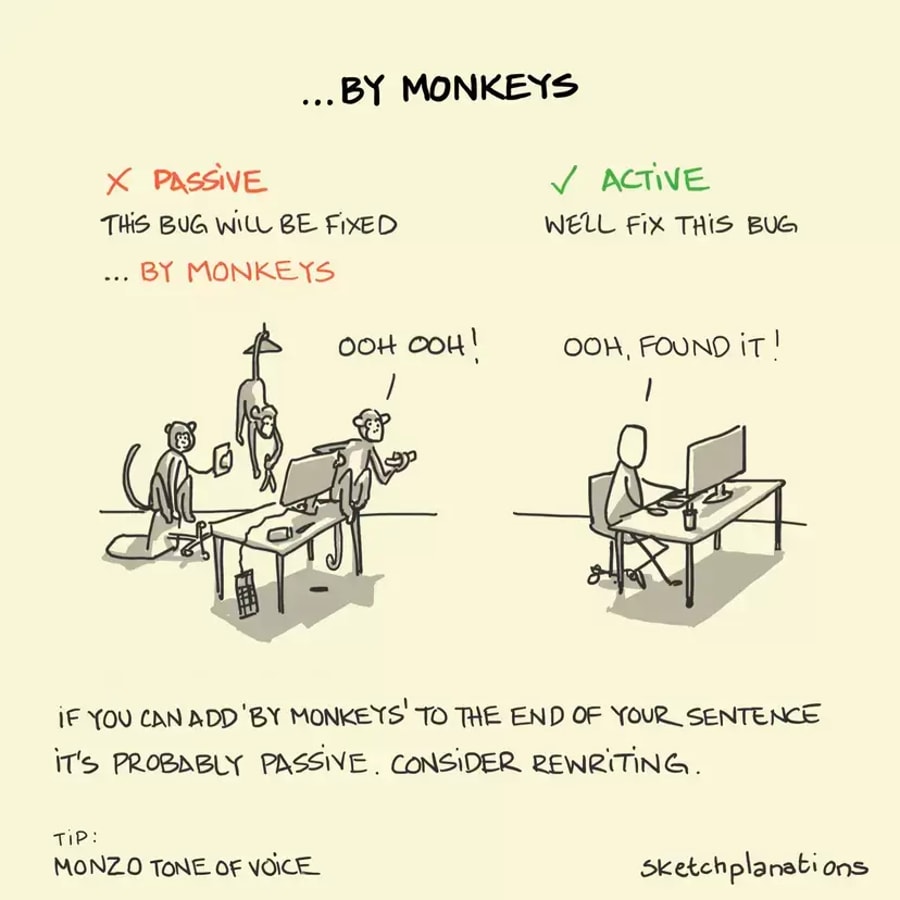
Credit: Sketchplanations
4. Test your readability
A readability score is a number that tells you how easy your text is to read. It’s based on the Flesch–Kincaid readability tests which looks at things like sentence length and word complexity. It’s calculated using the following:

Credit: Semrush
For general business writing, aim for an 8th-grade reading level (or a score of <60) or lower.
A readability checker can show how easy your writing is to understand. A good readability score means more people can read your content.
As the Content Manager here at Fleximize, I use tools like Hemingway Editor and Grammarly to keep my writing sharp.
Bonus tip: Read it out loud. If you trip over a sentence, your reader probably will too. Try:
- Swapping long words for shorter ones
- Breaking up chunky sentences
- Reordering them for better flow
- Cutting anything unclear or unnecessary
If it’s hard to say, it’s probably hard to read.
5. Use lists where appropriate
Lists break up blocks of text and make information easier to read.
There are two main types:
- Sentence-based lists have several points picked out at the beginning, middle, or end.
- A bullet-point list of separate points with an introductory statement (like this one).
Start each bullet with a capital letter if it’s a full sentence. Use semicolons for lists that continue a sentence.
6. Be careful with figures of speech
Metaphors and idioms can help – or hurt.
Pros: They can simplify complex ideas.
For example, “Think of cash flow like fuel in a car – without it, your business won’t run.”
Cons: Some might confuse people, especially those from different backgrounds.
For example, “barking up the wrong tree.”
Use them sparingly, choose ones most people understand, and consider explaining them if needed.
7. Write for your audience
Know who you’re talking to. Small business owners? Customers? Team members? They’re more likely to prefer plain language over technical words
- Complicated: "This product has been designed with scalability in mind."
- Plain English: "This product grows with your business."
If you’re writing for experts, some technical terms might be expected. However, always aim to make your writing as clear as possible.
8. Use examples and analogies
People understand new ideas better when they’re explained with familiar examples.
- Instead of: "Our software has an intuitive UI."
- Try: "Our software is as easy to use as a smartphone app."


Enjoying this article?
Sign up to receive regular insights to your inbox.
Quick takeaways
For effective communication, you should:
- Use simple, everyday words.
- Keep sentences short and to the point.
- Avoid jargon unless necessary (and explain it if you use it).
- Use active voice to make writing stronger.
- Check readability with free tools.
- Test your writing by reading it out loud or asking for feedback.
Using plain English doesn’t make your writing boring - it makes it clear. This saves time, builds trust, and makes your business more approachable.
It helps you connect with people, stand out in search engines, and cut through the noise of corporate speak.
By avoiding corporate jargon and using layman’s terms, you can improve effective communication with employees, customers, and partners.
Whether you’re writing emails, reports, or website content, using plain language ensures your message is understood by everyone. So next time you write? Keep it clear, keep it simple, and say what you mean.
Your common questions answered
No – but explain them in simple language when you do use them.
Using plain English makes a business look more trustworthy. When companies use simple, direct language, they seem more professional, reliable, and easier to work with.
Not at all. It’s more professional because it makes your message clear and accessible.
Not everyone has the same level of education or industry knowledge and may not speak English as their first language. This inclusivity can help businesses reach more customers and build stronger relationships.
Start by reading it out loud. If you stumble or run out of breath, there’s a good chance your reader will too – time to simplify.
You can also run your text through a readability checker like Hemingway or Grammarly to spot long sentences and tricky words.
And for bonus help, the Plain English Campaign has a brilliant alternative word list with simpler swaps for tricky terms. They’ve been fighting jargon, gobbledygook and vague public information for decades – well worth a look.
Do you have a question that you can't see? Check out our FAQ page.

How to Craft an SME Content Management Strategy
— Read More — How to Craft an SME Content Management StrategyHow to Craft an SME Content Management Strategy
Master the basics of content marketing with this simple guide for SMEs.


These cookies are set by a range of social media services that we have added to the site to enable you to share our content with your friends and networks. They are capable of tracking your browser across other sites and building up a profile of your interests. This may impact the content and messages you see on other websites you visit.
If you do not allow these cookies you may not be able to use or see these sharing tools.